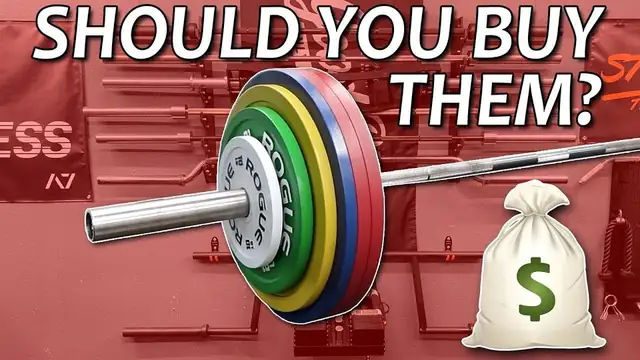
Calibrated competition plates are not cheap, so are they actually worth it? I've been training with Rogue's calibrated plates in my garage gym, and in this review I break down what matters: how accurate they are, how tight they fit on the bar, the one design flaw that bugs me, and the price. Then I get to the question everybody came here for: who should buy them, and who should save that money for other gear.
Video chapters
Looks and finish
I'll start with the obvious: I absolutely love the way these look. Most of my gym is black. Black floor, black equipment, a little bit of red here and there, and gray walls. The red, blue, yellow, green and even the white plates give the place a real pop of color. If I had gone with standard cast iron or machined plates, everything would be one color and you'd lose that.
They also look great on Instagram, and let's be honest, does it even count if you don't post it? I'm kidding. Mostly. The finish isn't the most durable in the world, but even once they get a little worn in, they still look really good to me.
What I like
- Pop of color that looks great in a black and gray gym
- Accurate to within about 20 grams, so no weighing and marking plates
- Tight center hole, so no wobbling or rattling on the sleeve
- Thin profile fits a lot of weight on the bar
- Gets you used to how competition weight looks on the bar
What I don't
- Expensive: at least twice the per-pound price of Rogue's standard cast iron when I filmed this
- Barely any lip, so you need two hands to load and unload safely
- The finish is not the most durable
Accuracy and tolerance
If I remember right, Rogue's website guarantees these to within 20 grams. That's about 20 paper clips. So a 25 is a 25, plus or minus 20 grams at the most. Some cheaper cast iron plates can be two to three pounds off, or more, on the 45s. Stack four or five of those per side on a squat with the heavy ones on one side and the light ones on the other, and you can end up with a swing of about 30 pounds between sides. Not a good place to be. The fix with cheap plates is to weigh every one and Sharpie the real weight on it. Calibrated plates skip that step.
The center hole is tight too. Sometimes they're almost hard to get on, though once the paint inside wears they slide on smoother. Looser plates wobble, rattle, and are more likely to work their way off even with a collar on.
The downside: barely any lip
My first real complaint, and one of the biggest for me, is that there's not much of a lip on these. That's what keeps them thin, so you can fit a ton of plates on the bar, but it means you pretty much always have to grab them with two hands. You can do it one-handed, but it's not a secure grip and you're always a little worried about dropping one on your foot.
With a deeper dish plate, you can grab it with one hand, pull it off the bar and swing it down onto your storage. That's not happening with these. On the bright side, you're sneaking in some grip training with everything else.
Price
This is the big one, and rightfully so. When I filmed this in 2020, these averaged a little over two dollars a pound new, plus shipping. The 55s were a bit over two dollars a pound, and the smaller plates cost more per pound. That's more than machined plates. Rogue's standard cast iron plates were just over a dollar a pound, so calibrated plates ran at least twice as much, and other places sell cast iron even cheaper than Rogue.
Back in the day you could grab plates for next to nothing on Facebook Marketplace or Craigslist. With the COVID lockdowns, used plates in a lot of local markets were going for two dollars a pound or more, so in some cases calibrated plates actually came out cheaper than buying used. Not cheaper than new cast iron, though.
Should you buy them?
If your budget allows it and you're a powerlifter, yes. They won't make you stronger. Plenty of seriously strong people train on regular plates because that's what they like. What calibrated plates do is get you used to how the weight looks on competition day. At a CrossFit gym with thick bumpers, 405 fills pretty much the whole sleeve. On a 55 lb squat bar, three reds a side gets you to 385 and one small plate a side gets you to 405, taking up maybe the space of one and a half bumpers. That can throw you off on the platform if you're not used to it.
I'd also say go for it if you want color in the gym and you're not sacrificing other equipment. If you can't afford them, don't sweat it. Your progress will be exactly the same with any plates, as long as they're the correct size.
Specs
| Weight accuracy | Within 20 g (per Rogue's site, as I recalled it) |
|---|---|
| Colors | Red, blue, yellow, green, white |
When I filmed this in November 2020, the calibrated plates averaged a little over $2 per pound new plus shipping (55s just over $2/lb, smaller plates more per pound). Rogue's standard cast iron plates were just over $1 per pound at the time.
FAQ
Are calibrated plates worth it for powerlifters?
If your budget allows, yes. They won't make you stronger, but training with them gets you used to how the weight looks and loads on the bar on competition day.
Will calibrated plates make me stronger than cast iron plates?
No. Your progress will be the same with any plates as long as they're the correct size. Calibrated plates just get you used to competition loading.
How accurate are Rogue calibrated plates?
As I remember from Rogue's website, they're guaranteed to within 20 grams. Some cheaper cast iron plates can be two to three pounds off or more on the 45s.
What's the biggest downside of calibrated plates besides price?
There's barely a lip to grab, so you pretty much need two hands to load and unload them safely.
Written by
Rick HuseGarage gym builder and the guy behind Garage Gym Gainz. Everything here comes from my own hands-on video review. Watch the full video above, or catch new ones on the channel.